How it all began
Sitting in a local café in the old market of Nazareth, I poured down my rambling thoughts in an attempt to organize them into a structure, to understand them and to reflect upon them. As a Palestinian living in Israel, I am confronted with many contradictions in my daily life. Just now, on my way to Nazareth, I stopped for a woman who was hitchhiking to Maskana junction (now it is called Golani junction after the Golani brigade serving in the Israeli army). I offered some help to a fellow woman who had probably served in the army, who has been occupying my people. As I sat there sipping my cappuccino on a late lazy afternoon in February, I wrote down incessantly, as if my stream of consciousness would run along the furrows of my mind; down my dark brown eyes into the pen that would scribe down words in a foreign tongue. English is my second language, yet the ease with which my feelings find an outlet to the outside world is fascinating. My mother tongue is Arabic- a language I deeply love and adore, and yet it is a language that I grapple with; it’s a language I write and use but can’t feel at ease with – as if it is constantly judging me. I’m telling you it is a weird feeling. I’ve been writing in English, like my journals, since I was 16 years old. And only in the past couple of years have I been experiencing the difficulty of writing in English. Not for any other reason but ideology: Why am I writing in English if my mother tongue is Arabic? Is this the result of colonization? Am I another servile victim of globalization? The mere idea just irritates me, so I set out to explore this question, among other questions on writing in English, by seeking to talk to other native Arabic-speaker (mainly Palestinians) who write in English.
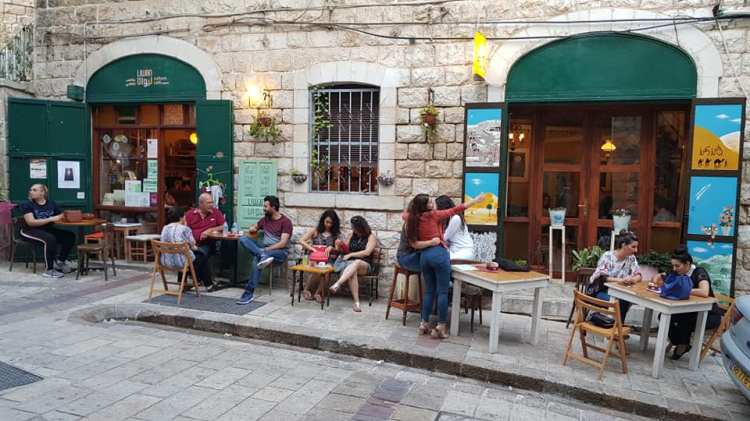
(Liwan cultural Cafe in Nazareth)
Writing is a way of self-expression
Writing is a way to express one’s self, which is, according to Issa Zaatary, one of the most important things in life. Issa is an art major in the University of Haifa, and he’s an avid reader, listener, music player and appreciator of arts. When I spoke with Issa, one of the issues that came up is the complexity of writing songs and poems in English: on the one hand, the English language provided him with an escape from the reality imposed upon him, since he went to an Arab-Jewish school, where Hebrew and Arabic were the means for communication, and thus English was a haven away from such a reality. On the other hand, English is not his mother tongue, it is a language that is not his, although he expresses himself perfectly in it. It is as if he allies with the language, but the language is independent from any alliances. What makes it even more difficult is his conviction that Arabic language is beautiful and romantic, but the fact that he finds it inaccessible can be frustrating.
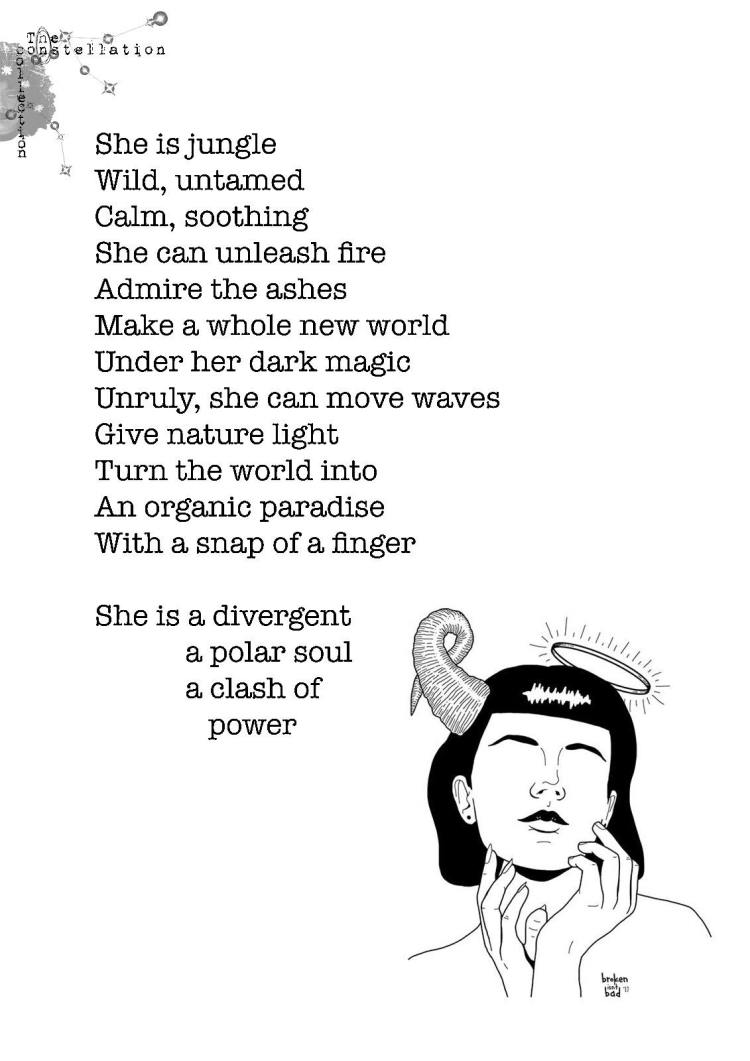
Such frustration with the Arabic language is also shared by Noor Habib, a second year English Literature student. She highly appreciates the Arabic language, and yet she does not use it for writing, even from a young age (she started writing her journals in English at the age of 16). She thinks that we’re not taught the Arabic language well. It seems so distant from the events of the daily life, that when one wants to express the way she feels or experiences, Arabic shuts her out. Although a bit bitter, Noor enthusiastically hails improving the pedagogy of Arabic language. One of her favorite poets is William Shakespeare, and as she answers, she laughs and tells me “it’s a bit cliché, but Shakespeare is a genius! Especially after I studied him at university, I became more aware of the amount of his genius” She writes her own poems and she shares them on Instagram by accompanying each poem with a sketch or an illustration. (her account: @theconstellationcollection)
It’s the way we learn Arabic
Noor’s comment about the way we’re taught Arabic in schools prompted me to think of how the schism between the spoken Arabic and the written Arabic is reflected in the reality- after all, as we read in theory class, language shapes reality. So how does this gap affect our lives? I wonder. I believe that this makes communication harder, since the formal Arabic is reserved to write about “serious issues” like politics, economy, and religion, while the spoken Arabic is reserved for the “day to day” and rarely takes part in the artistic scene (maybe in Rap?). Upon sharing these contemplations with Aziza Okab, she responded that we should write poetically in the spoken Arabic, like in the Spoken Word events. Aziza finished her master’s degree in English at the university of Haifa and is currently working as a content writer, and writes frequently on her website. Her motivation to engage the spoken Arabic in the artistic circles is reflected in her attempt to combine Arabic words in her poetry written in English, and her initiative to have spoken word events in Nazareth and Ramallah. She is unapologetic about writing in English. She tells me over the phone “English and Arabic are both my mother tongue, I grew up in the states and I came here at the age of 12.” Aziza aspires to write as a way of fulfilling herself.
English reaches a wider audience
Yara Yazbik also considers both Arabic and English her mother tongue. She grew up in the States and then moved back to Nazareth, studied English Literature at the University of Haifa and she is currently working in a tour-guide company. Yara says that writing in English enables her to reach a wider audience, especially after she lived in Japan, where she was felt like an alien and found in English a way to express her meditations on home. When asked about the locality of her audience who might not understand her poetry, she said that many people here speak good English and are capable of relating to what she’s writing.
Another English major student, Alice Hanna, sees in writing in English a way to self-express. Especially since she sees that writing in Arabic is so challenging and hard, and that Arabic educations lacks emotional education. We learn about old, pre-Islamic texts but don’t learn how to describe our relationship to our surroundings nor to people in our lives. Alice added, although at the beginning, studying English Literature at Haifa University had distanced her from writing due to the huge amount of essays and reading, but that such education allowed her to better read and to think about things. She still writes and she’s currently finishing her English degree. She says she’s passionate about the English language, but she won’t become an English teacher, which is the common idea that everyone supposed about almost all English majors.
How to negotiate this whole situation?
Angela Obeid, an English lit graduate from Haifa University, does not only have two mother tongues but three! She speaks Arabic, English, Italian and Friulian. Her mother is Italian and her father is Palestinian. She hopes to write a novel in English one day and she’s currently working as an English teacher. She reconciles her writing in English with her reality by the fact that English is a global language spoken by many people in the world, and on the other hand we haven’t our mother tongues, like Arabic, Italian or any other language, so it’s not an issue for her.
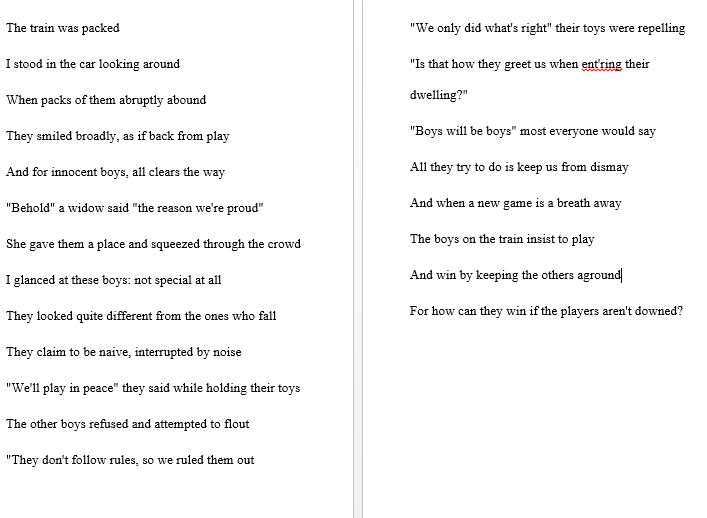
Ihab Azar, on the other hand, believes that precisely in order to face these questions and issues, he writes. Since writing helps him to deal with difficult situations and to process his emotions. For example, check his poem on the train that talks about the complexity of getting on the train in Israel (this same incident has been beautifully written about by Khulud Khamis). Ihab likes to combine music into his poetry, so he’s very astute to meter and rhyme (as also shown in his following poem).
Talking with these young, ambitious writers and performers helped me reflect upon this issue in different ways. I have come to realize few points which are the following: Arabic is a beautiful language, and we should put efforts to make it more accessible or at least to think about how to bridge the two languages (the spoken Arabic and the formal Arabic). In addition, I am more encouraged to write in English so I can explore this beautiful language and to probe its depth. The politics of writing in English has not disappeared but I merely think that on a national level: it’s okay to write in English as long as there are others members of the community who are writing in Arabic. Moreover, it’s an obligation to write in Arabic and to translate universal and global works into Arabic (even coding languages perhaps?). However, the artistic responsibility of authors under colonization should never stand in the way of authentic expression of emotions and transcendence. I believe there is value in wiritng as an activity- be it in Arabic or in English or even in Hebrew. I imagine that in the future Palestine, we want all sorts of writers and we should not limit our world and our vision under the guise of “pure nationalism”. On an individual, personal level, I believe that each person has a way of self-expression, of negotiating contradictions and of constructing one’s story, and if this mean of expression happens to be writing in a “foreign” language then it’s okay- it’s actually amazing! But on the condition to be aware of this fact, to never relinquish self-investigation and to see how writing in English plays a role in the personal perception of the reality that one lives and the reality that one wishes to have.
Finally, I thank all the beautiful persons who were willing to put up with my questions and long phone conversations. If you want to check my other articles and some of the poems that I write, this is the place – my blog.

 AICHA BINT YUSIF
This is an insightful and wise entry about the nature of language, culture, and the mind. I have found myself uncomfortable at times as an English teacher that I am perpetuating the colonialism of language, but after discussing the issue with students found they mostly felt English was a tool to benefit the learner. How blessed you are two speak both Arabic and English so fluently. I predict you will gain insights into life, culture, and learning that monolingual people will never have. Like most Americans. 🙂
LikeLike