Shortly after the terror commenced on the 7th of October, I reached out to a friend of mine in Barcelona about how helpless I feel. She felt helpless, too. Attending protests and screaming outloud hasn’t stopped the terrorist state in its genocidal undertaking to kill children and innocent Palest!nians. Out of helplessness and hopelessness, the idea of having a watermelon wirting workshop was born. The watermelon, if you’re not familiar with it, came to symbolize Palestinian Sumod(steadfastness) and existence/resistence. In other words, we (Kudwa Association and myself) decided to have a workshop to write down our heavy emotions and process the pain and agony of witnessing the genocide one Meditterranean away. As I was preparing the material for the workshop, I thought, surely by then (November 18th) there would be a permanent ceasfire. Oh how wrong was I, and still am, as I’m writing these words (the 20th of December) the unslaughter has been ongoing.

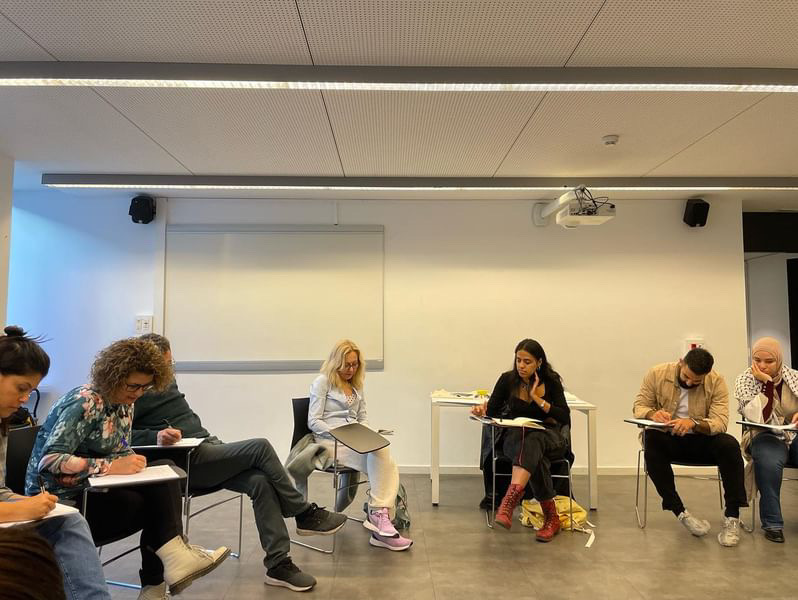
We met at Veinal space in Barcelona on a sunny, fresh Saturday morning at 11am. We were 18 persons in total, and we sat around in a circle, in an attempt to provide protection and intimacy for the participants to share and read freely and safely. After presenting Kudwa (and I highly recommend you do too- this is their website), I presented myself. My voice was shaking when I spoke about why we’re doing this- we’re witnessing a genocide and we feel a whole range of emotions that need to be processed personally, but also, and most important, collectively. After a round of introduction to get to know each other, I realized we have a quite diverse group: young and old, European and Arabs, amateur writers and others who rarely tried to write. Somehow these differences were less important, as we were all brought together for the sole reason that we feel we need to write down our experience and our emotions; that we all care about what is happening. I have to confess that I was a bit nervous about how to create a safe space that allows people’s participation and is not hindered by political correctness or identity roles. This problem manifested itself in terms of language: which language should we speak? Spanish, Arabic or English? and what about Catalan? Somehow, this was less of an issue really, as we spoke freely mixing all of the mentioned languages. According to the evaluation form we sent to the particiapnt, all of them were happy with how we used different language flexibly and smoothly.
Back to the course of the workshop, we did an introductory exercise to warm up. After 8 minutes of continuous writing, some chose to share with us what they wrote (which was really beautiful). Later, we did two more writing exercises, giving the chance to share after each one. By now, it was 12:30 and we had to take a break. Razan, the founder of Kudwa, generously provided us with tea, coffee and arab sweets (her family was visiting from Syria and brought Syrian date sweets). Over coffee and tea, we talked and got some rest before we went back to anotehr short exercise. Lastly, we read and dicussed 3 poems: first was how to write a poem in a time of war by Native American poet Joy Harjo, second was مساء صغير على قرية مهملة by Palestinian poet Mahmoud Darwish, and the third and last poem was Explico algunas cosas by Chilean poet Pablo Neruda. The discussion was very rich. I learned more and I got different perspectives about the poem. What do the shadows represent in Darwish’s poem? what about the images in Harjo’s piece? And Neruda, talking about the Spanish Civil War, hit a chord that resonates with many of the particiapnts who were born and raised here. In addition, these poems asked us very difficult questions: what do you do in the time of war? how do you write poetry during these difficult times? and what role does the poem, or the poet, play during the time of genocide? and can the written word change anything?
Here are some photos of the workshop and screen shots of particiapnts’ reactions to the workshop 🙂
Hopefully for many more, only i hope it’s not to write in the time of genocide, nor of civil war, nor of another tragedy striking the south or the north. I hope to conduct a watermelon writing workshop in the time of liberation, of justice, and of dreams. Wide wide dreams that can fit all our desired and potential happiness.


 AICHA BINT YUSIF