It is not professional because I am not an anthropologist- I only took two anthropology coursees during my English Literature degree, and it’s unintended because I was not planning for it- I was staying in Haifa after a long period of being away, and I ran into many people, with whom the conversation just naturally arrived to the question: what happened during the “events”(al ahdath) ? where were you? what were you doing?
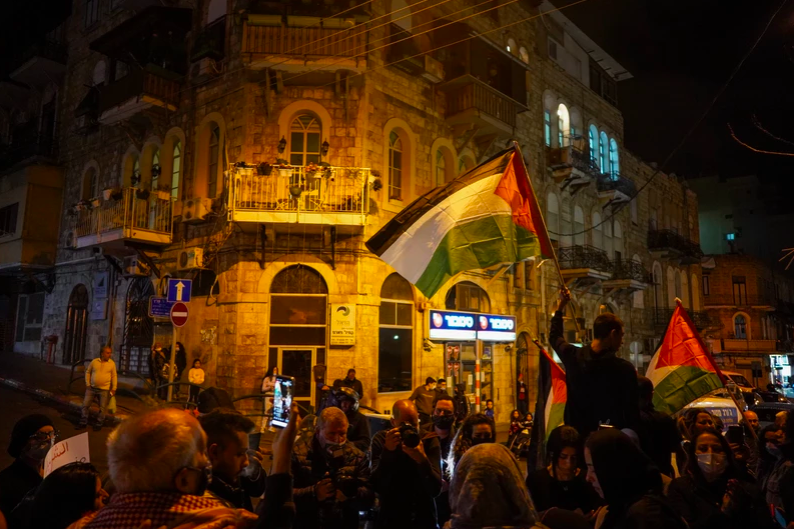
The Events are the series of violent attacks carried out against Palestinian Arabs in Israel, which took place stimulaneously during the heavy, asymmetric, Israeli bombing of Gaza. From now on I will refer to these Events as al-ahdath, as I think it’s more fitting. Nonetheless, bear in mind that some people call it the Uprising, or Al Quds Uprising. I use alahdath or ahdath-mayo because I think what happened didn’t amount to an uprising nor was it a revolution, it was rather a vicious and scary spree of violence conducted by Israeli extremists (protected by the state apparatus) against Palestinians everywhere, and especially inside Israel proper.
I watched what was happening in Haifa from the other side of the Mediterranean. Mainly, I followed al-ahdath through social media, namely Facebook and Instagram along with conventional media outlets like Haaretz, Ynet, and Arab48. Witnessing al-ahdath from a far distorted my sense of proportion of things. After all, I saw my beautiful city of Haifa on fire: tires being burnt to block the police and mobs of armed Jewish extremists walking around familiar streets so they set up make-shift checkpoints to hunt Arabs. I saw videos of Arabs being chased down the street; of Arab houses being marked by extremists to attack them later. Many people called those nights the Broken Glass night, referring to the November pogrom that was carried out by the Nazi Party’s Sturmabteilung paramilitary in 1939 Germany.
That being said, I expected my visit to Haifa to be shocking and shaking, but it was not. I felt that things are back to “normal”: things seemed to have picked up right from where they had stopped. Other than the fading graffitis in Masada st and Wadi Nisnas, I didn’t observe any tangible change in the physical space nor the social space. As I spoke and reflected out loud with my friends and acquaintences about these conflicted feelings and observations, I came to realize and draw a different, nuanced reality that the city is living at the moment. In this humble blog post, I would like to share this reality and the discrepancy between what is observed and what is felt.
Haifa has always been hailed as the city of coexistence, a place where Jews, Palestinians, Russians and other ethnicities and religious communities live side by side. For this reason, during al ahdath, the horror of witnessing the flimsy, fake image of a shared community being shattered to pieces was overwhelming. A Palestinian Arab friend of mine described it as the following: “I was scared to leave the house to go the hospital where I work. I bought portable pepper spray for my family members to carry with them at all times. What terrified me the most was the fact that we’re left alone. No one protects us but ourselves, especially when the cops made this fact clear by blatantly protecting the Jewish extremists in their quest to target and kill Arabs.”
An American friend of mine who has been living in Haifa for couple of years, depicted her experience witnessing another surge in violence and bombing as the following: “It is so weird how the realities of people here are separated. When all the violence was rampaging through the city, my colleagues (who are mostly Israeli Jews) maintained their routine of a “normal” life: yoga classes at the beach, restaurants having discounts and people complaining about the damned virus and the state’s reaction to it. It was unbelievable how two people can live in the same place and yet live a totally different reality. While my Palestinian friends were stressing out and scared about what’s happening, my Jewish Israeli friends were not. Moreover, after the ceasefire was announced, things just went back to the usual as if nothing has happened; as if this not uncommon wave of violence and rage is normal. Seriously, people here are so conditioned to abnormality.”
Another friend who works at one of my favorite cafes in Haifa described it as an inevitable turn of events- it had to happen at some point. He told me that although it was really frightening to live through al ahdath, it had awakened a sense of solidarity and unity among the members of the Palestinian community inside Haifa, and across all historic Palestine. Actually, this is the first time since the Land Day 1976 or the Popular Revolt in 1936 that our people across borders and seas share a common struggle and fight. He felt that he belongs to an active group trying to build and protect itself. The predicament made us stronger, he said as he made another espresso. Indeed, as most of us witnessed, the grassroot Palestinian community inside Israel provided the services that the state failed to fulfill. For example, when unknown extremists set fire to the mountain near Sakhneen in the Lower Galilee, the people of the town were suffocating as the fire fighters refused to enter the sprawling town fearing that they will be attacked by Arabs. People took the matter into their hands and went into the mountain, risking their lives to put the fire out. Other services like healthcare, protection, food provision were also provided by humble and spontaneous inner organizations, mainly young people. In Haifa for example, the Haifa Youth Movement took an active role in organizing the Palestine Economic Week: an initiative across historic Palestine calling for economic independence and active boycott of settlement products and economy.
As I walked in Wadi al Nisnas to my usual roasting house to buy coffee, I met with the owner a really good falafel shop. I asked him about the situation, and he said that things are hard. People are tired, and there are glimpses of hope here and there but it is difficult. During al ahdath and for the months following, there was an active boycott of Palestinian stores and restaurants by Israeli Jews in Haifa. The deep hiatus dividing people only grew deeper. The community is still trying to recover from its wound. Another friend who works at a local bakery told me: they missed their fresh falafel and good hummos so that’s why they broke the boycott, and things are back to “normal” now. It’s not about us- they see us as producers of these things to be consumed”
Another international friend tells me as we walk around down town to get to Al-Makwa to shield us from the scolding heat: I don’t want to make this about me, but I felt out of place. I felt limited in my ability to understand or to ally myself midst all of this. I mean, my position is clear and I support the Palestinian community, but I felt people looked at me with suspicion and I couldn’t express my solidarity. Although I’m Jewish but during al ahdath, I stopped talking to my Jewish Israeli friends who were still providing excuses to the horror that we were witnessing. I found some solidarity with other internationals here, but it was really hard to play an active role. After drinking cold coffee to dispel the heat, he surprised me with a conclusion: I feel like I have more contribution as an international on my own community by raising awareness about what’s happening here, but I have no place to force people to trust me or to play an active role in the struggle.
ِAn Israeli friend (who is not Jewish) described her experience neutrally. She told me over the phone: I was just more careful but I wasn’t scared for my life. I was dumbfounded! how can anyone be neutral about this? As if it’s a natural part of life? I was a bit furious at the end of the conversation (see? this is not a professional recount of what happened because I’m emotionally involved). I think she failed to see the bigger picture of systematic injustice against the indigenous Paletinian population. Telling me that both sides participated in the violence is not untrue, but saying they’re equal is. We both know that the Police arrested more than 300 young Palestinian (some of whom are still in jail) while very few Jewish extremists were presented before justice. This is the asymmetry: the state is built on the values of Jewish superiority and that’s a fact.
A fellow friend who at the beginning of al ahdath left Haifa to stay in her town told me: I went back to my town (that was later attacked by the police and border control forces) and I felt a strange feeling that I haven’t experienced in years. As you know my town has been spearing the headlines with the rate of organized crime taking place: theft, extortion and murder form a part of our daily reality. However, during al ahdath the violence among the members of the community stopped. Zero crimes in my town and neighboring villages as well. This is beyond me- the systematic threats of the police made us closer and more compassionate towards each other. I know it sounds twisted but I wish we go back to those ahdath, at least we won’t have a daily victim of organized crime in the Arab community. It is important to note that the day the ceasefire was announced, two persons were killed in Umm Al-Fahm.
After I had these conversations, I still had a sense of unease about the situation. I feel angry that I missed on a great collective experience. I feel lucky that I missed the horror of being here. I feel warm to be surrounded by familiarity that hasn’t changed, despite the attacks and the fear. I feel frustrated that things have not changed. I feel motivated that things have changed. I feel all the mentioned above and more.
Finally, the momentum is waning away, but the trauma is not. We don’t talk about things that have happened. When I asked the bartender at my favorite cafe the next day about what he experiened during these ahdath, and how did it change his perception of the reality here, he scuffed and said this is a question that only ashkinazi people ask- what do you want me to tell you? We’re under occupation. The words resonated in my mind as I strolled down Hadar’s steep streets, and a sole idea kept presenting itself to me: we’re asking the wrong question.
I must ask: is there hope?

 AICHA BINT YUSIF