First you begin with a recipe, that’s how all short stories begin. The ingredients vary and so does the taste. His main ingredient is sorrow. He would like to warn her, but her persistent eyes and hospitable smile override his attempts. The 91-year old Karim sits hunched over his seat, basking under the Basque sun, asking himself for the millinoth time: from where does one begin a story?
he opens his mouth to narrate the ancient story he has been carrying with him for the past 9 decades, but only half sigh half laugh syllable comes out.
Ya zarif el toul wagef ta goulak
Rayih a’alghorbeh wibladak ahsnlk
The beginnings of things are always sung. The beginning of a war is the drum; the beginning of love is a prayer. The last time he heard this song sung to him, it was when his sister was crying and his mother was choking on tears but kept smiling too, telling him to stay safe and come home soon. He left the port of Haifa on a Tuesday morning, and the last pair of eyes he saw were his comrade’s Khalil- I won’t let you down, the eyes said. She smiles as he sings to her under the Basque sun in an Arabic tongue. He also smiles; his smile adding another line across his furrowed face with life tracks and paths. “This is the beginning of who I am: a song of departure, trying to coax me not to leave my hometown Atlit to the other side of the Mediterranean. But I was convinced, I am still conviced that it was the right thing to do: to help our comrades in Spain to beat the Fascist forces. I thought we would come back, the Palestinian Communist party thought we would come back with the international brigades after liberating the iberian peninsula. But here I am, savoring the shafts of light that rarely reside on the Basque land”. Khalil’s eyes were the last thing he saw, as he turned westward facing the sea courageously, knowing that he made a big move, but he will be back. Sitting in Zarautz, he reminisces on his first impressions of Spain: he can still smell the Mediterranean sea brushing his face, the smell of Barcelona’s port when he arrived and the fish that he tried for the first time. The eyes spoke as he spoke little Spanish, and no Catalan at all. His English that he learnt from the nuns in Nazareth Sisters school in Haifa would be helpful. His Arabic he would write many letters but he rarely received any letters back.
She sits comfortably and listens carefully. His Arabic is a bit tentative, as if jumping on big rocks on Akka shore. He speaks slowly, with grace. She wouldn’t believe that she is here. She also arrived to Barcelona couple of days ago, only to a busy airport and not to a war-stricken country but to a modernist, urban city filled with life. She landed with a fancy plan to pursue studies at the University of the Basque country and to fight in her own way- knowledge.
He sighs in pain and relief. Karim runs across the Navarra mountains for refuge. He is separated from the rest of the legion and he is confused. One would imagine that he would think of his past life, of Atlit or his family, but the only idea that kept presenting itself was: solitude. I’m alone in this world, and there’s no one who will live this life for me. I can fight and I can help, I can read and I can talk, but I’m all alone here. Life is so miserable and so beautiful- he keeps running trying to evade the bullets and the commotion. Years later, when he meets Augustina, things will change. As if romantic love will pacify the existential gales storming his heart. He was being smuggled across the French border, and she was there- she brought chorizo, cider and cheese to the fighters in the mountains. The Basques were fighting for their lives and existence against Franco’s regime. The day Gernika was bombarded for three hours on the evening of the 26th of April, killing hundreds and tearing down lives, the messenger boy would add that the Oak Tree of Girnika is in its place, at the outskirts of the village, waiting for your return. After many springs since that boy climbed the hill, Augustina and Karim would visit the ancient oak tree later, they hold hands as they walk up from the train tracks to the cafe in front of the Museum of Peace. The beginnings of things are always sung: The Zionist militia in 1948 invaded Palestine, conquered his Atlit and expelled his family first to Akka then to Lebanon. Augustina squeezes his palm, reminding him that she is there next to him-always.
“What’s your name?” he asks. “Oruba” she replies. And he scuffs unconsciously. He doesn’t mean to offend here, but oruba is the lost dream of all Arab nations, and he is very cynical lately. Augustina comes back with a coffee kettle, some cookies and water. She moves graciously and waters the plants. At first they (augustina aand oruba) struck a small conversation in Spanish: cómo estás? Cómo te llamas? Cómo llegaste aquí? But then she feels the need for her husband and this young Palestinian woman to have their time, so she waters the plants quietly.
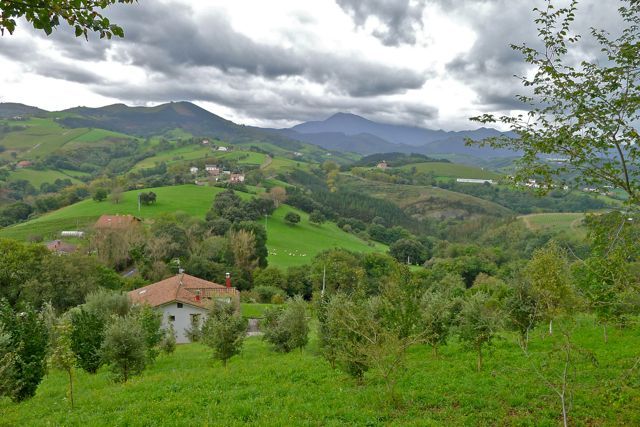
Since her studies begin next week, she decided to explore the region as to familiarize herself with her new home for the next two years. Her bags and luggage are not even organized yet in the new room she took in downtown San Sebastian, or Donosti as the Basques call it in their native language Euskera. First she walks around the coastal town of Getaria. A small town with a big harbor and fancy restaurants. The famous sailor Elkano embarked from here to travel around the world in his ship. She buys ice cream from a local gelato and keeps climbing the way up the plaza where a huge statue of Elkano greets her. The sea waves crash against the rocks and spray her with fresh water. She keeps walking westward along the coast. On her right, the green mountain is dotted with small cottages and houses. Zarautz is the next town that meets her. It’s a long 1.5 km walk, so she sits down in the local bar to have fresh orange juice.
Do you have grandchildren? She asks him, and he says yes but they live in Madrid. She wonders who was the waiter at the cafe earlier during the day. When she was in the bar, she glimpsed a poster of Palestine’s right of return behind the bartender, and he said that a waiter used to work here that put it there, and maybe he has relatives from there. In fact there’s an old Palestinian man living here in Zarautz. But he’s all about being basque, he has an Etxea and speaks Euskera.
Will they believe me when I say
In the future
That I was walking in a foregin land
When I met a piece of my land, grown and grey
With roots in the soil, blossoming in the air?
She is not a poet, but this incident is too great just to pass by like this. He asks about the situation, about the olive groves, about Atlit’s fortress and Atlit’s beach, he asks about everything and nothing. She draws a picture of reality in front of him. She doesn’t hide anything nor does she pretend: Atlit is a Jewish settlement now, and its beach is private. It has a train station that connects it to Haifa and to Tel Aviv. I studied architecture in Tel Aviv but I don’t like it. I’m from Kufr Kana but my mom is originally from Lubieh. Yes people fought in Lubieh but the Zionist forces were stronger. Yes we’ve lost but we have not surrendered. It’s depressing. Yes I swear and they speak in broken Arabic and don’t know who is Salah El Din El Ayobi nor Al Manfalouti. I am going back for sure. Definitely to build and design our new villages.
He sits on the porch, watching the silhouette of the trees becoming deeper against the setting sun. The mountains here are still foreign to him, and he will never admit this to Augustina. It’s too late now to ruminate on the past- just live. At the age of 45, he still convinces himself to live. What has he been doing all these years then? Preparing to live? That’s not true. He lived, he lives and he will live. He misses the sound of Aad’an. And the pain of being away from home hits hard in his guts. He feels the pressure in his insides and he breathes deeply, knowing that some suffering is only necessary. When he was 22 years old, he had no doubt, things were clear in front of him, like his goal of liberation, his origin and his story, even his body was certain. And he thought that with old age, deep certainties will grow roots and become stronger, but that’s not true. Time proved to decay certainties and beliefs. As if a test to weed out all frivolous, flimsy beliefs. What is this life really? He writes a poem in Arabic and buries it deep. Euskera is a beautiful language but he can never admit that there might be other more beautiful language than Arabic. “Who am I to tell you and what should i tell you?” Mahmoud Darwish. I’m not a dice player. I make conscious choices and I face fate with will to power. I choose to stay in Basqueland, I choose to stay with Augustina. I choose not to go back to Palestine. I choose to live another life out of my own- or did I? I choose to teach my daughter and son Arabic, even if it’s broken. I choose to raise sheep and to farm the land. I choose to work as a clerk and to quit work. I choose and shaped the life that I have. I choose to keep making choices.
Oruba’s eyes have a bright light in them. She is vibrant with life. She will tell the story of meeting the Palestinian in the Basqueland in a deep house in a village on the mouth of a green mountain, surrounded with apple orchards. She will tell about how the waiter at the bar told her about the only Palestinian he knew in Euskal Herria (Land of the Basques) and how she will meet this only Palestinian and have coffee with him. Karim observes the signs of restlessness in her- she’s young and she’s about to conquer the world. Seeing her awakes a sense of relief in him: I was like her, restless and time has quenched my interminable quest. He is different now. He loves the fresh air and the morning walks by the ocean. He is sad about Palestine and he wishes he could have liberated it. But now Palestine does not seem so important, and even his sadness about the situations is drunk from a glass of a foreigner, just like Augustina is sad he is also sad. He wouldn’t share this idea with her, because it’s the idea, the concept of Palestine as the goal and the end of an action that is exhilarating and capable of providing endless energy to push her forward. He is not going to ruin this wave for her, let her swim, ride the waves, reach the island and touch the rays of the sun.
Can she ask him why he never came back? Why has he settled here? she wasn’t entitled to ask and he wasn’t obliged to answer. The breeze scatters her thoughts, and she realizes that she should get going. Augustina gives her a bag full of figs and apples, and prints a kiss on her cheeks. Karim smiles in pain as he gets up and prints two kisses (the Spanish way) and walks her to the entrance of the Etxea. Only then she notices that his house has a name, and its name is palestinarrak. He sits on his desk, and sees her from across the yard, reading the name of the Etxea with a half-smile, and he writes:
The most important ingredient for a fight is pomegranate seeds…

 AICHA BINT YUSIF