In his Poetics of Space, the French philosopher Gaston Bachelard writes that “we must describe what we imagine before what we know” (25). In a similar way, imagining public space through art and literature is one way of changing, reclaiming and owning the reality of that space. Since the “spatial turn” in the 50s of the past century when Bachelard published his book, along with Lefebvre who published his famous work Theory of Space, the meaning of space, land, and landscape gained more importance both in the academic realm and the artistic scenes.
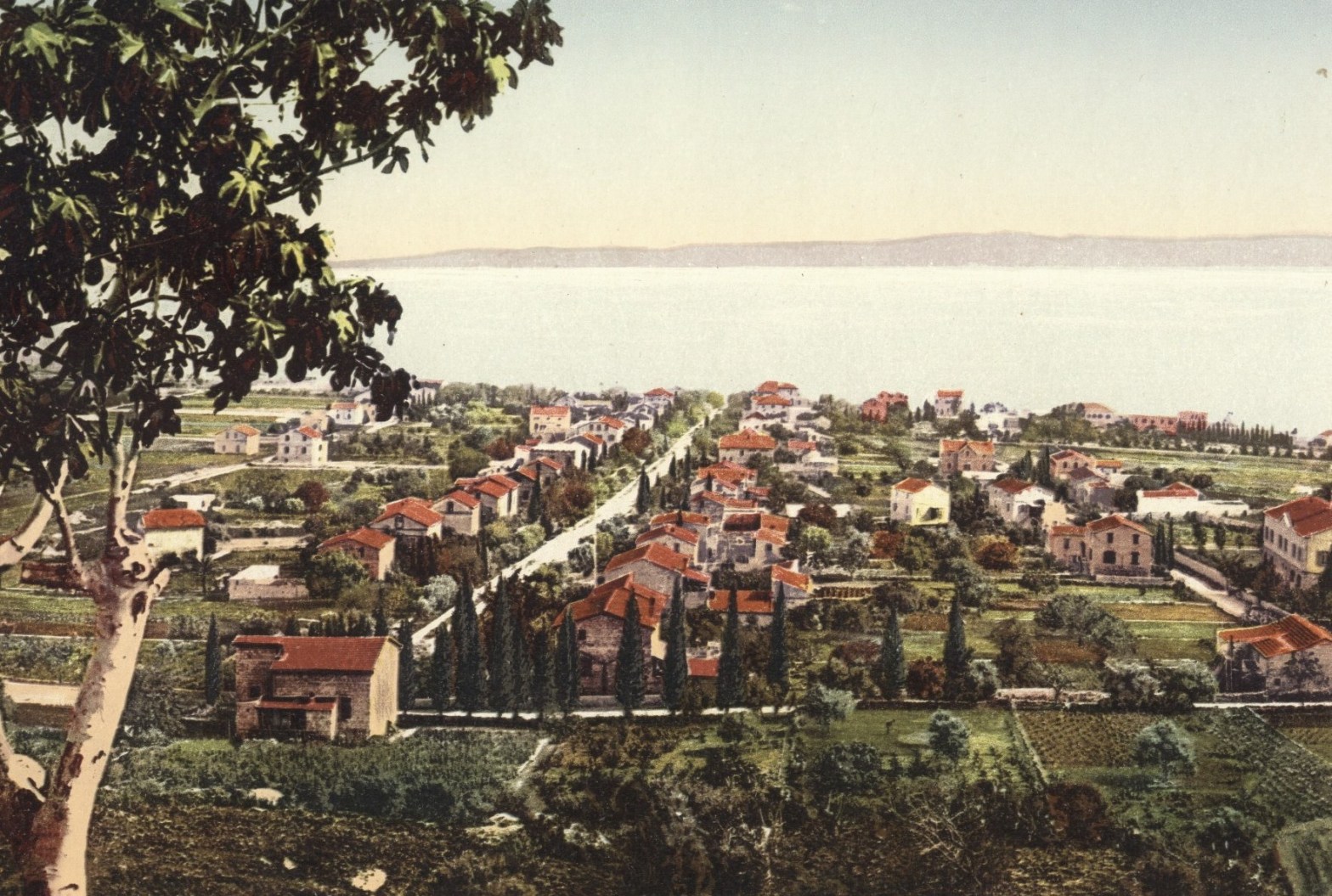
Haifa is a young small city on the coast of the Mediterranean. It was born about 250 years ago[1]. Even though the city has been hailed as the ideal actualization of the hope of coexistence between Palestinians and Israeli Jews, the reality can offer nuances to such appellation. Whether it’s the gentrification of Wadi Al Salib (called Harit El Kanayis before the Nakba in 1948, when the Israeli Zionist militias bombarded the city and kicked out its citizens) by liberal Israeli artists and business entrepreneurs or the effacement of the original Arabic street names, cemeteries and features, the city is going through a conflict. A spatial conflict.
In 1989, the Haifa-born historian Johnny Mansour published a book about Haifa street names. This book traces the original street names of Haifa prior to the Nakba. For example, Ben Gurion ave was called Carmel st. Ha-Nasi ave was called Snobar st (pine st). Omar Al-Mokhtar st was turned to Ivnar Naftali st. And many other examples that show how changing the spatial features of the city is inextricably related to power structure and dominion. Just outside of Haifa’s city hall, there’s a small park that overlooks the city’ bustling port. In the middle of the green lawn, there’s a stone statue that commemorates the liberation of Haifa in 1948. And one has to wonder, liberated from whom? From its indigenous population?
Art and music play an important role in resisting power structures by challenging the status quo. Faraj Sulieman, pianist and musician, released his second album recently. One of the featured songs is called “Sharia’ el Jabal”; lyrics written by the writer Majd Kayyal (who has already published two books inspired and based in Haifa). Jabal st refers to today’s Hatsionot st (zionism st in Hebrew). Not only does the lyrics challenge the status quo of the space by calling it by its pre-Nakba name, but also the video of the song that shows the Palestinian buildings in Haifa. When I say Palestinian buildings I’m referring to the old-bricked stone houses scattered in the down town and Wadi Al-Salib neighborhood. In fact, the only modern building shown in the video (the rocket building) is smashed to pieces.
In addition, the local youth movement of Haifa (حركة شباب حيفا) created an ingenious way to reclaim space by setting up a monthly, mobile library in different, mostly Arab neighborhoods in Haifa, such as Wadi El-Nisnas, Al-Mahatta, Al-Kababir. People visit the mobile library, they exchange (mostly Arabic) books, connect with the youth of the city and be present in the dominated public spaces of Haifa.
Another way of claiming space is through sports. Right to Movement is a running community that was founded in Bethlehem in 2012 to emphasize the restrictions on movement in Palestine. The community has many groups all over Palestine, one of which is in Haifa. The group meets twice a week and runs along the beach to tell a different story. Imagine a group of young and old Palestinians coming from different towns and villages, wearing a T-shirt that says “Right to Movement Palestine” along the beach. If this is not actively reclaiming and occupying public space, then I don’t know what is!
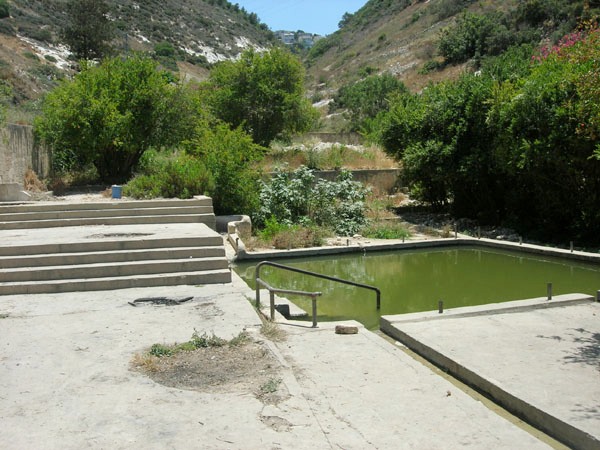
On the Western outskirts of Haifa, close to the beach, Bustan Al-Khayyat resides in the shade of the pomegranate and fig trees. The Bustan (Arabic for Orchard) was built by the aristocratic Al-Khayyat family. The orchard today is abandoned since Haifa’s occupation, and despite the numerous attempts to renovate the place, the municipality of Haifa didn’t approve. Recently, an outdoor community started a page called Masar (Arabic for trail) to encourage people to go out for hikes and to get to know the landscape of our beautiful country. The group, along with RTM, organized a run along the 300+ stair case that climbs the Carmel hill: starting from Al Khayyat orchard all the way to the Kababir neighborhood. Here’s a video of the event.
Source: https://www.alteerah.net/alteerah-detail.php?id=310&ty=nasha
Today, many young persons in the city call the streets of Haifa by their original Palestinian names. Such an action is, albeit subtly, challenges the power structure imposed on the Palestinians in Israel. Moreover, as reclaiming public space through art is a peaceful way to connect and protect the history and heritage of the space, it’s only fitting to say that Haifa is not only witnessing a thriving artistic, cultural transformation (as Nadeem Karkabi, a Palestinian anthropologist, wrote about the identity of Haifa as the Palestinian cultural capital[2]) but also as a place where power is being challenged and a new vision is being drawn.
[1] https://mada-research.org/en/files/2013/12/Mada-Johnny-Mansour-English-Final1.pdf
[2] How and Why Haifa Has Become the “Palestinian Cultural Capital” in Israel, City and Community

 AICHA BINT YUSIF