Storytelling is a craft and an art. In our Palestinian community, storytelling is an essential component of our identity. We tell stories and we listen to stories all the time: that time when you went to Al-Souq (the farmer’s market) and the man behind the vegetables stalls started telling you a story about the apples his got from [the occupied] Golan Heights. Or maybe you got on the bus and you heard the bus driver and a fellow passenger engaged in a conversation talking about the recent elections and its different failures across the Palestinian community in Israel. Or maybe you went to see your grandmother and she invited you over for A’kob, and started telling you the way things were in her time. We’re not bringing something new, storytelling is part of who we are. But this time, we wanted to use the art of storytelling to bring a specific group as away of empowerment and active engagement between different members of the society. So Hala Salem and I [Aicha Yassin] held a storytelling workshop with the women’s club “Afnal Al-Galil” in my hometown Arrabe.
The workshop was held in my family’s old house. It is a two room house built from old stones and arches as a pillars, just like the old way of construction. This house has been passed down from one generation to another, and not long time ago my great grandmother Om Al-Sharif (her name was Aicha and I was named after her) lived there and thrived as a powerful, influential character among women in Arrabe’s community. The workshop lasted for two hours to include different kinds of exercises both in storytelling and movement (Hala Salem is movement artist and dancer).
First, we got there early and waited for the twenty women to arrive. We had Arabic coffee and some dates while admiring the crafts and handmade bags and shawls made by the women. Angelica Najjar, the founder of the organization, welcomed us warmly and encouraged us to come again and be an active part of the organization’s work. The two rooms are separated by flight of four stairs, since as my dad has told me, the lower room was used as a storage unit to house wheat, which was placed in containers built from straw and mud. It was also used to house the animals during the cold winters that the Batof area witnessed (actually here’s a fun fact, the lowest weather degree ever in the region was in the Arrabe meadow in the early previous century).
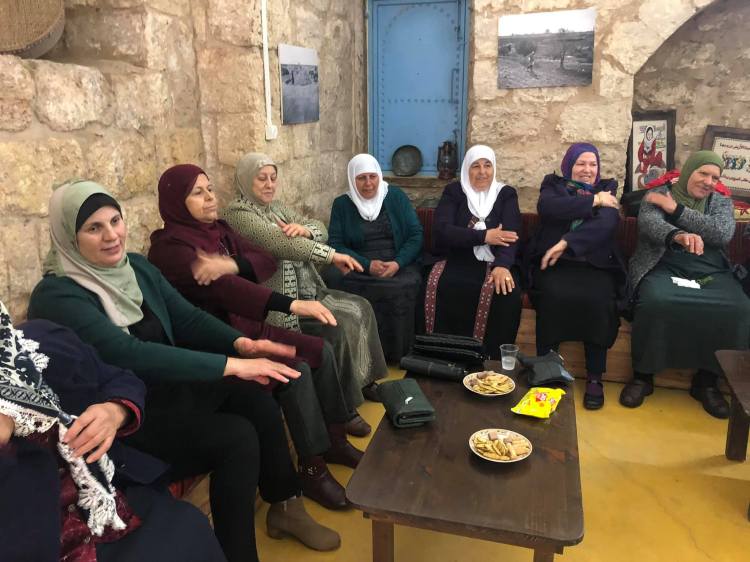
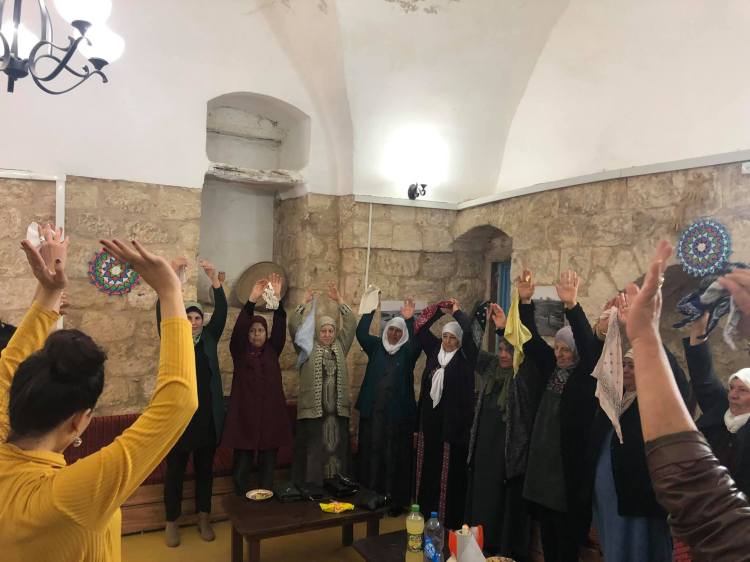
All of the women present were over 60 years old, and at the beginning we thought this fact would be a challenge for us, since we’re the millennial kids, with which a huge generational gap exists. So as to break the ice, we started the workshop with some movement exercises to shake them out of their hard controlled demeanor. After some rounds of movement exercises, we moved to the first storytelling exercise, to hear the story of their names and what does it mean for them. They were very engaging and told us beautiful stories. For example, Jamila was called after her great grandmother and she thinks that her name is part of her identity, since she thinks of herself as beautiful (Jamilah means beautiful or pretty). Then we did some more movement exercises with their scarfs. Last empowering exercise was to help them think of a positive thing that they like about themselves accompanied with a movement they chose.
At the end of the workshop, we asked the woman to sings a traditional ululation about brides, especially since Hala has noticed that most traditional songs sung in wedding are about the groom or the groom’s mother, and thus as an attempt to revive and to emphasize the importance of the bride as well, they sang us a song dedicated to the bride/ the woman. We danced and clapped and shared their happiness (as you see in the video). They asked us for more workshops like these, especially since they thought that a connection was being built without generation that is different (although two women still criticized the torn jeans Hala wore).
After the workshop, I reflected upon such an experience thinking that these strong women are lively and inspire determination and good energy towards their place in the society. They made me feel that I belong to this society, despite its negative aspects and numerous problems. They made me feel less alienated and more welcomed, despite the differences between us. The power of a story, of a cup of coffee in my old grandmother’s house is fascinating. And I thought how much we need these meetings to build a bridge and to strengthen the foundations of our society. To nurture plurality, to contain difference, to celebrate stories and to remember tradition together has a huge positive impact on our lives as individuals as well as a community as a whole

 AICHA BINT YUSIF